How does it work?
Scanning
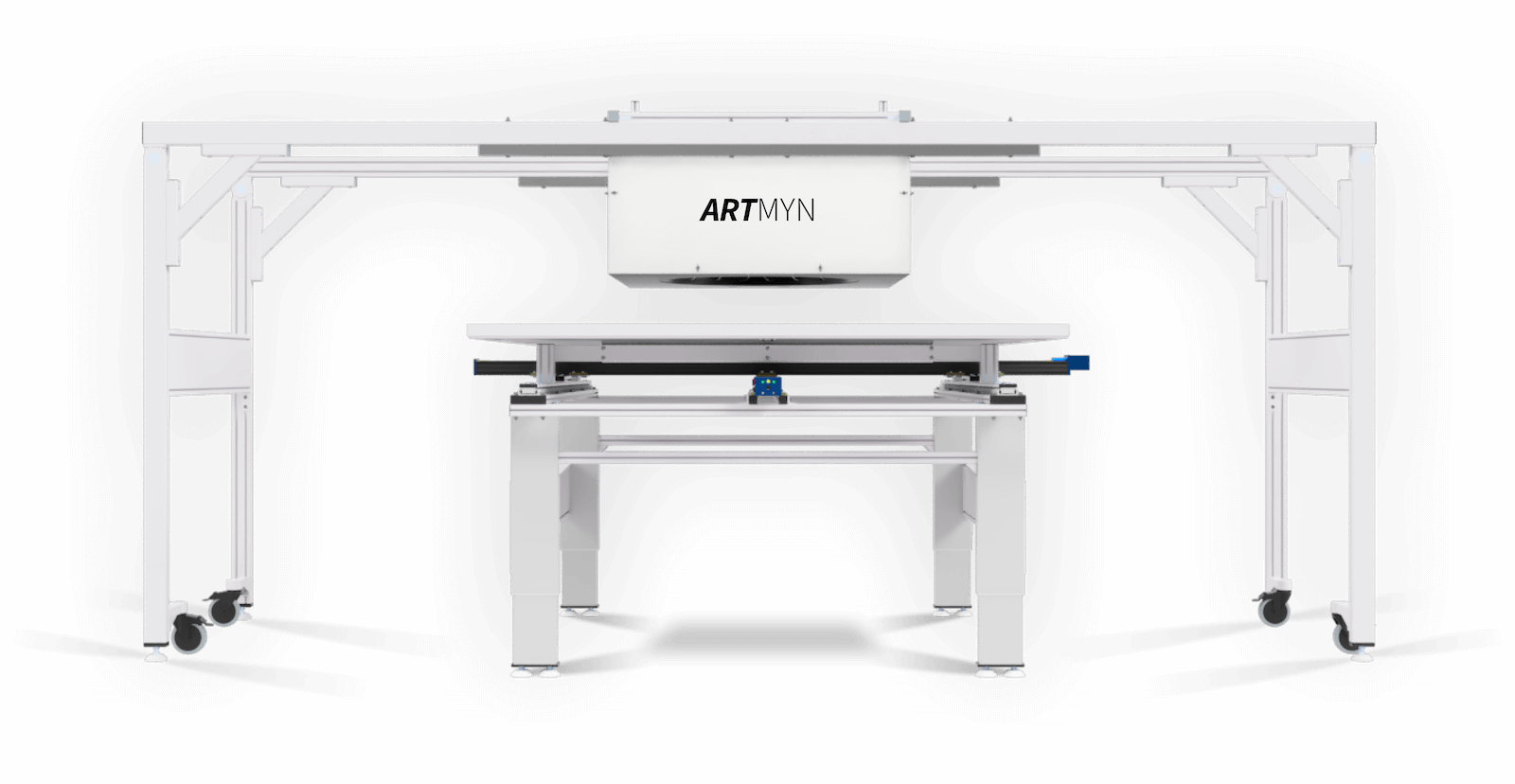
The artwork is first placed under the scanner and its scan is launched via the computer interface.
The device moves seamlessly across the surface, recording every detail using illumination from multiple angles and wavelengths.
The resulting dataset is instantly transferred to our servers, allowing processing to begin while the scan is still in progress.

Processing
Visualisation
Access the digitized artwork instantly through our interactive viewer in your browser.
Explore microscopic details, switch between spectral layers, change light orientation and navigate the piece with smooth, responsive performance — no specialized software required.
67 lights
To capture original works under Visible light, Ultraviolet, Infrared and topography
2000ppi
State-of-the-art precision for art scanners
2 x 2 m
Scan artworks up to 2 meters on each side (6.56 ft).
99% four-star
FADGI compliant — built for true museum-level accuracy.


FADGI Compliance
FADGI (Federal Agencies Digital Guidelines Initiative) sets the benchmark for image quality, color accuracy, and reproducibility in cultural heritage digitization, with four-star representing the highest level of performance.
Our technology achieves 99% four-star FADGI compliance, verified through testing with the latest analysis software and reference targets from Image Science Associates — delivering museum-grade fidelity trusted by leading institutions worldwide.

Safe for your artworks
Our scanning technology is entirely non-intrusive, designed to protect even the most sensitive works.
Thanks to extremely short illumination times, each scan exposes an artwork to a total light dose equivalent to roughly 16 minutes under standard gallery lighting (~50 lux). For optional UV and NIR imaging, UV-A and NIR sources are activated only for milliseconds (200 ms and 660 ms respectively), minimizing any potential impact.
Once digitized, the artwork can be studied in detail indefinitely — with no further light exposure to the original.
Discover our scanning centers

Online Portal

Versatile Format Coverage
Digitize flat artworks up to 2 × 2 meters (6.56 × 6.56 ft) with constant capture resolution exceeding 2000 ppi, delivering exceptional detail regardless of artwork size. Perfectly suited for paintings, books, coins, photographs, antiquities, and more.
The system accommodates surface relief up to 2 cm (difference between highest and lowest point), with no restriction on canvas frame depth or book thickness.
Want to know more?
